From copper wire to live flight ADS-B data
Table of Contents
From Copper Wire to Live Flight ADS-B Data
ADS-B (Automatic Dependent Surveillance–Broadcast) is a system where aircraft continuously broadcast their GPS position, speed, altitude, and other flight data over radio. Unlike radar, it delivers highly accurate, real-time updates with minimal delay and works even in areas without radar coverage. The signals are sent on 1090 MHz (worldwide) and 978 MHz (mainly in the USA), and because they’re unencrypted, anyone with a simple antenna and receiver can track flights.
I’ve had an old RTL-SDR (Software Defined Radio) dongle for a long time and haven’t done any projects with it in a long time. I’ve been dreaming of my own flight radar and taking pictures with weather satellites for a long time, so I thought now would be a good time to start and try something fun from the RF world and make homebuilt ADS-B Antenna & Flight Tracker.
Software
The software I used in this project is ADS-B Feeder Image which makes aircraft tracking easier than ever before.
ADS-B Feeder Image has the ability to receive and feed data from various technologies such as ADS-B, AIS, ACARS/VDL"/HFDL, Sonde. Everything is pre-assembled and set up and after the image file is placed on the memory card they are also ready for use. It supports a wide range of Supported Software Defined Radios and Single Board Computers.
I feed the data I collect into one tracker that doesn’t require logging in and that is adsb.fi, a community-driven flight tracker, with over 3500 feeders around the world. It provides open and unfiltered access to worldwide air traffic data.
Antenna design & hardware
Hardware I will be using.
- Raspberry Pi 4b
- RTL-SDR dongle (version 2 ?)
- Diy spider antenna (1090 MHz)
I was researching information on easy DIY antennas and came across a simple spider antenna design. This is perfect for my project because it is small and cheap.
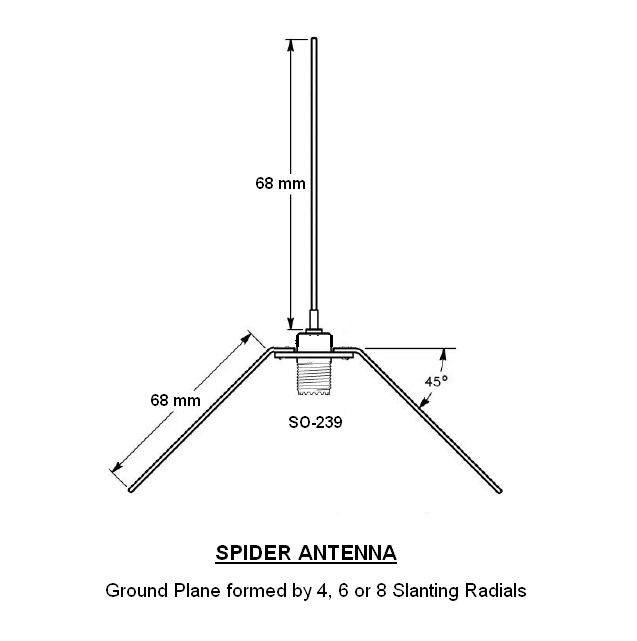
- Vertical whip cutted to 1/4 wavelength and measured to: 68mm
- Radials (4, 6, or 8) also cutted to 1/4 wavelength : 68mm
- Radials bended to 45 degree, so it antenna then will be about 50-60 ohm.
You can read more about antenna design here:
https://discussions.flightaware.com/t/10-groudplane-spider-antenna/17811/18
Making of spider
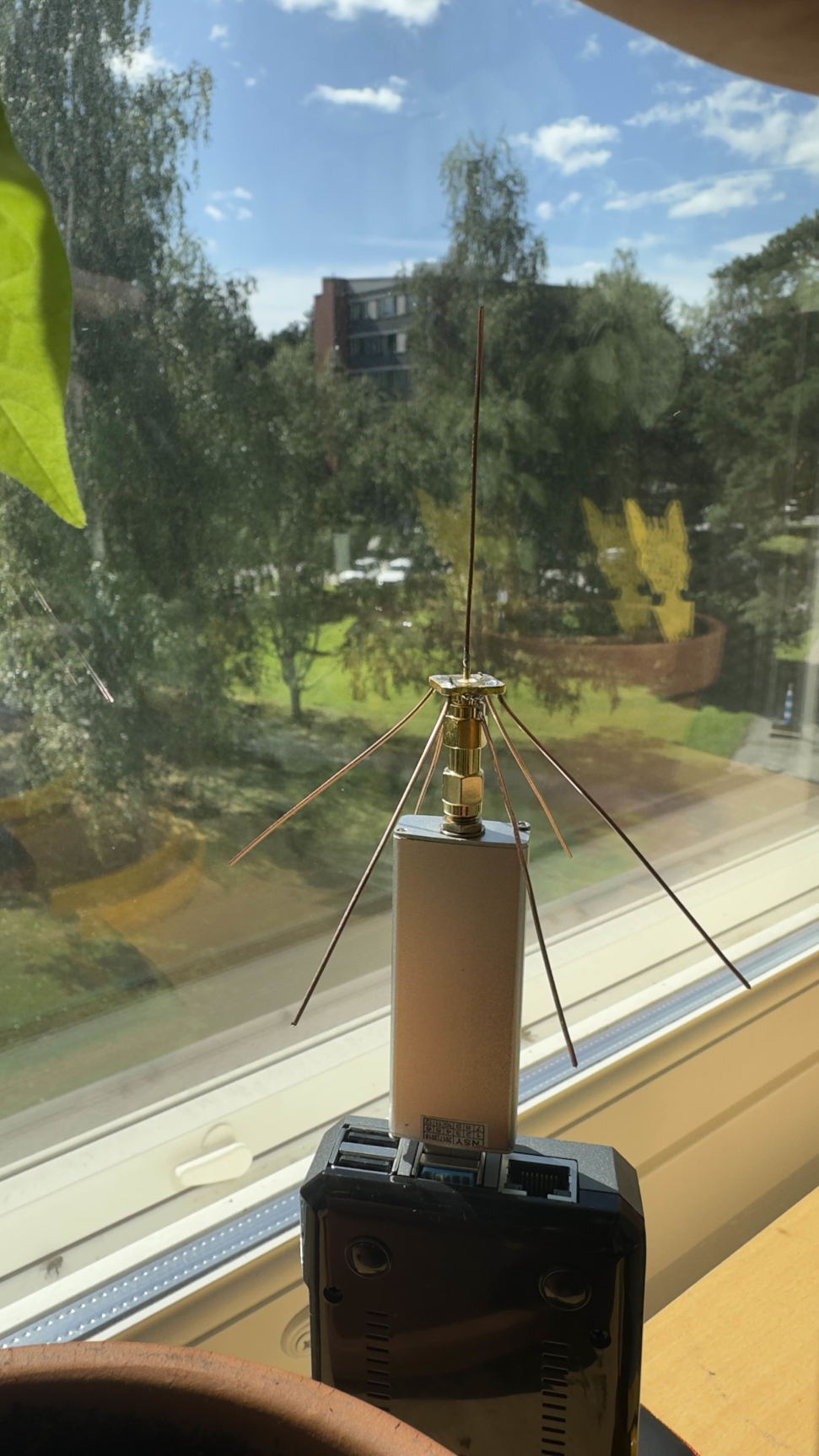
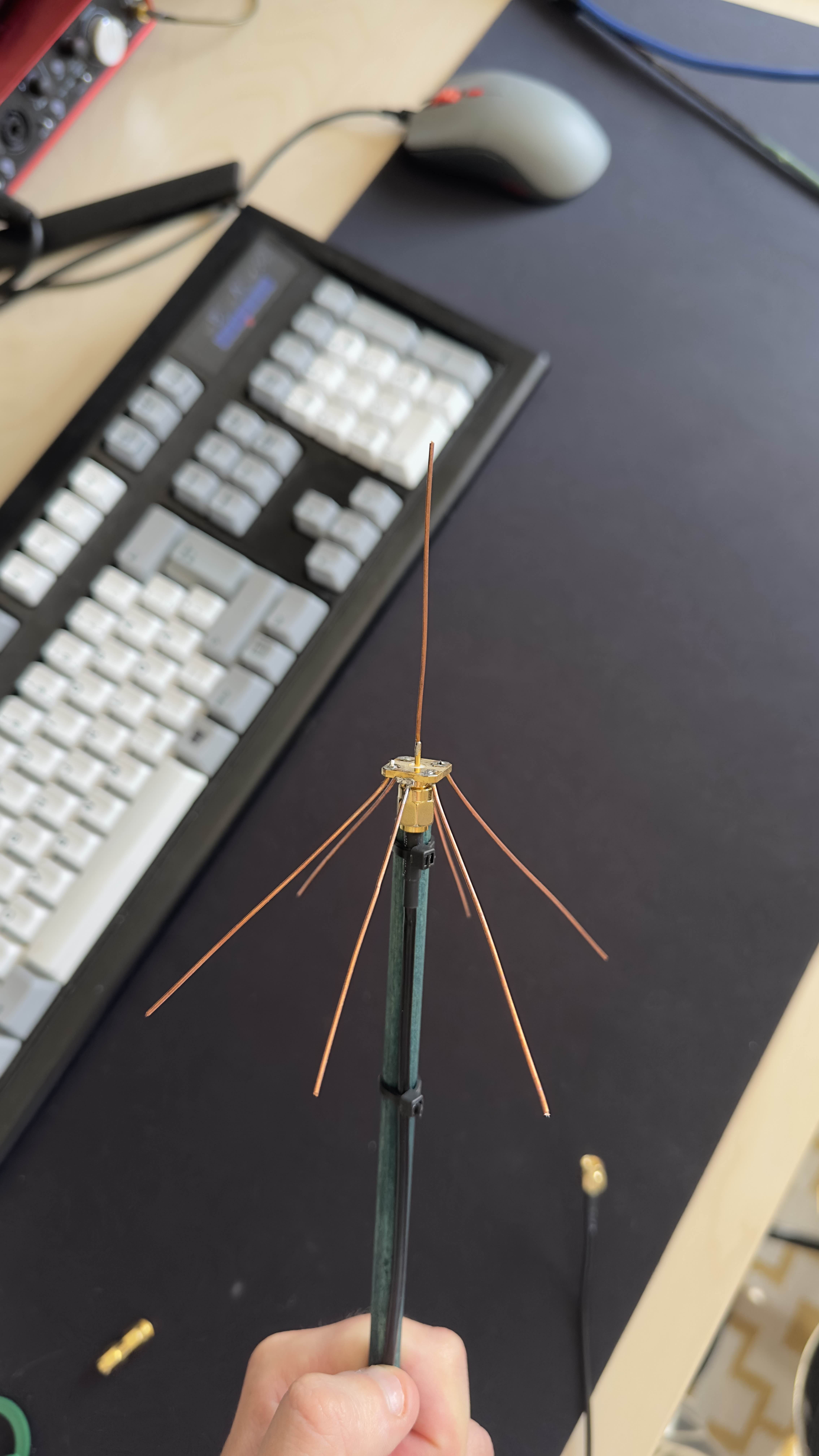
My first version was a four-legged spider antenna with solid 1mm copper wires soldered directly to an SMA trunk connector. I almost immediately soldered two more legs, making a total of six radials.
That’s it! An awesome six-legged antenna, it was time to hook it up and see how it perform.

The antenna was connected directly to the SDR radio without an amplifier or filter and I placed it indoors by a window.
Coverage
I was initially really surprised at how well the antenna performed and I started seeing planes on the map right away. After the initial surprise and adjusting the GAIN, I saw how far the antenna could reach and which ones were outside its range.
I wasn’t happy. The range didn’t get any better even though I moved it closer to the window and tried to position it better. There were some areas out of coverage on the map, especially in the back of the map where you couldn’t get through the window.
Something had to be done.

Placing the antenna outside
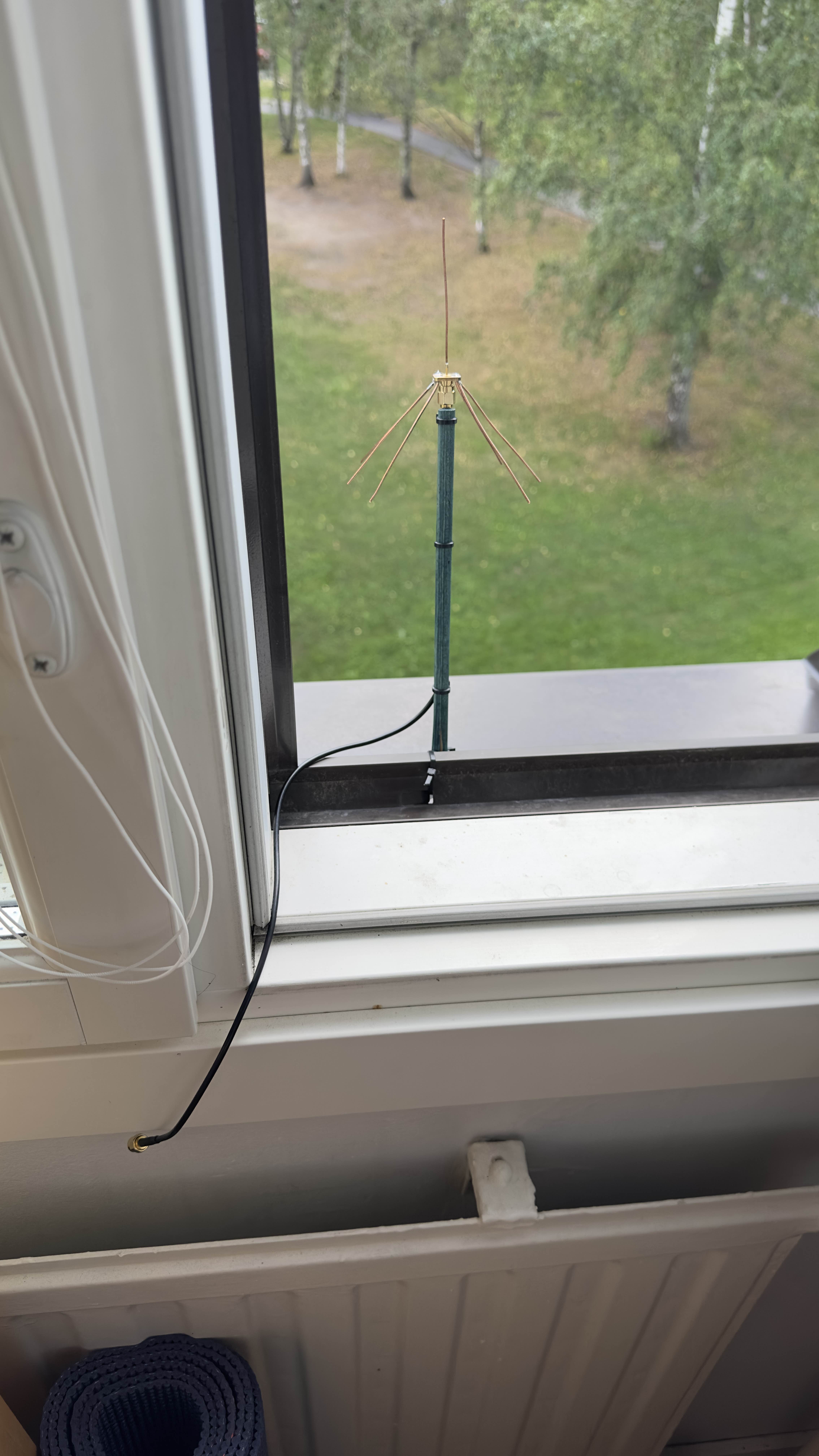
In order to increase the coverage area, the antenna had to be placed outside. I quickly made a stand that I was able to attach without drilling any extra holes in the walls of the house or my own window frames.
My very stylish “KUKKAKEPPI!” -stand attached to the window frame.
Coverage after placing
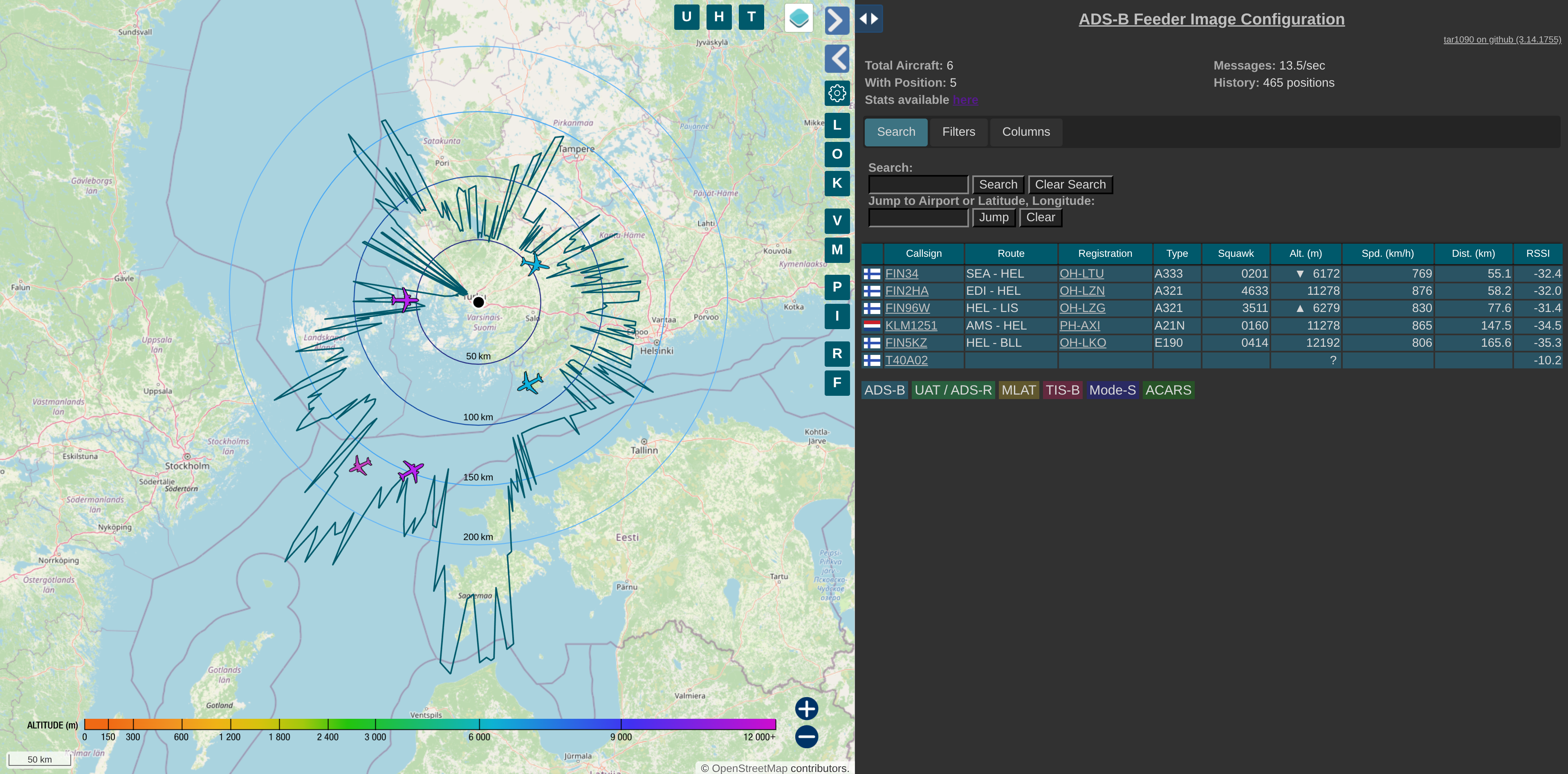
Wow! Repositioning the antenna had a big impact on ADS-B signal reception and the SRRI quality also improved a lot. I don’t think I can do better at the moment and with the equipment I have and especially without an amplifier. However, the original goal was already achieved and I can be satisfied with this.
The longest coverage so far has been 162.8 nautical miles (301.5 kilometers), which is much more than I could have imagined! The signal carried all the way to neighboring Estonia and almost as far as beloved Sweden.

Improvements for the future
Here are some things I can do to improve reception and quality. I will implement these as I can.
- Low noise amplifier (LNA)
An LNA can help improve ADS-B reception by reducing the noise figure of the system and by helping to overcome losses in the coax cable and/or any other components such as switches and connector in the signal path. To get the best performance from an LNA, the LNA needs to be positioned close to the antenna, before the coax to the radio.
The gain of the RTL-SDR Blog ADS-B LNA is 27 dB’s at 1090 MHz, and out of band signals are reduced by at least 60 - 80 dB’s. Attenuation in the broadcast FM band and below 800 MHz is actually closer to over 100 dB’s. In the LNA signal path there is first a low insertion loss high pass filter that reduces the strength of any broadcast FM, TV, pager or other similar signals that are usually extremely strong
- Saw filter
SAW filter tuned for 1090 MHz. A second SAW filter sits on the output of the LNA. The result is that strong out of band signals are significantly blocked, yet the LNA remains effective at 1090 MHz with a low ~1 dB noise figure.
- Better placing/rotation?
With placement and rotation of antenna i can influence how the signal carries and in which direction. The problem is that I can’t place the antenna on the roof, but near a window and wall.
- New SDR dongle
The new dongle has better features than my old dongle.
Update: 8 Radials antenna upgrade
I also modified the antenna so that it has a total of 8 radials. No significant changes, but I’ll show it at the end of this post.
